
GRADE 7 MATH · LEARNING PATHWAYS 2.0
Learn what a unit rate means, how it connects to ratios and division, and how to use it to make smarter decisions. Then practice 12 questions with instant feedback.
01 · DISCOVER
Enter your full name and school email. These will be used when you submit your score at the end.
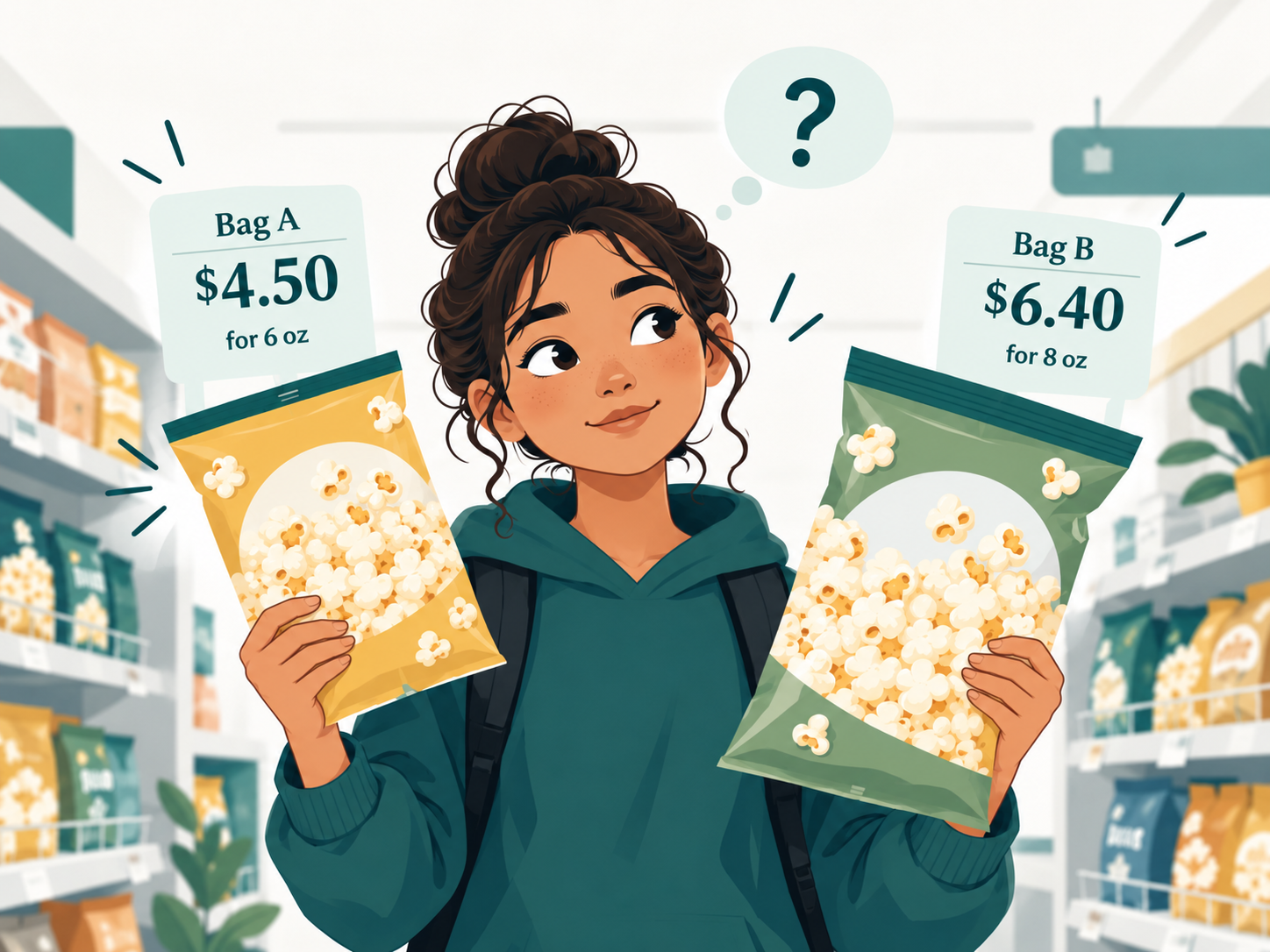
Imagine you’re shopping with a limited budget. You find two bags of popcorn. Which should you buy for the lowest price per ounce?
We cannot simply choose the lower total price. To compare fairly, both prices must be expressed for the same amount: one ounce.
By the end, you will explain unit rates, calculate them using division, check their accuracy, and use them in everyday situations.
02 · BUILD YOUR FOUNDATION
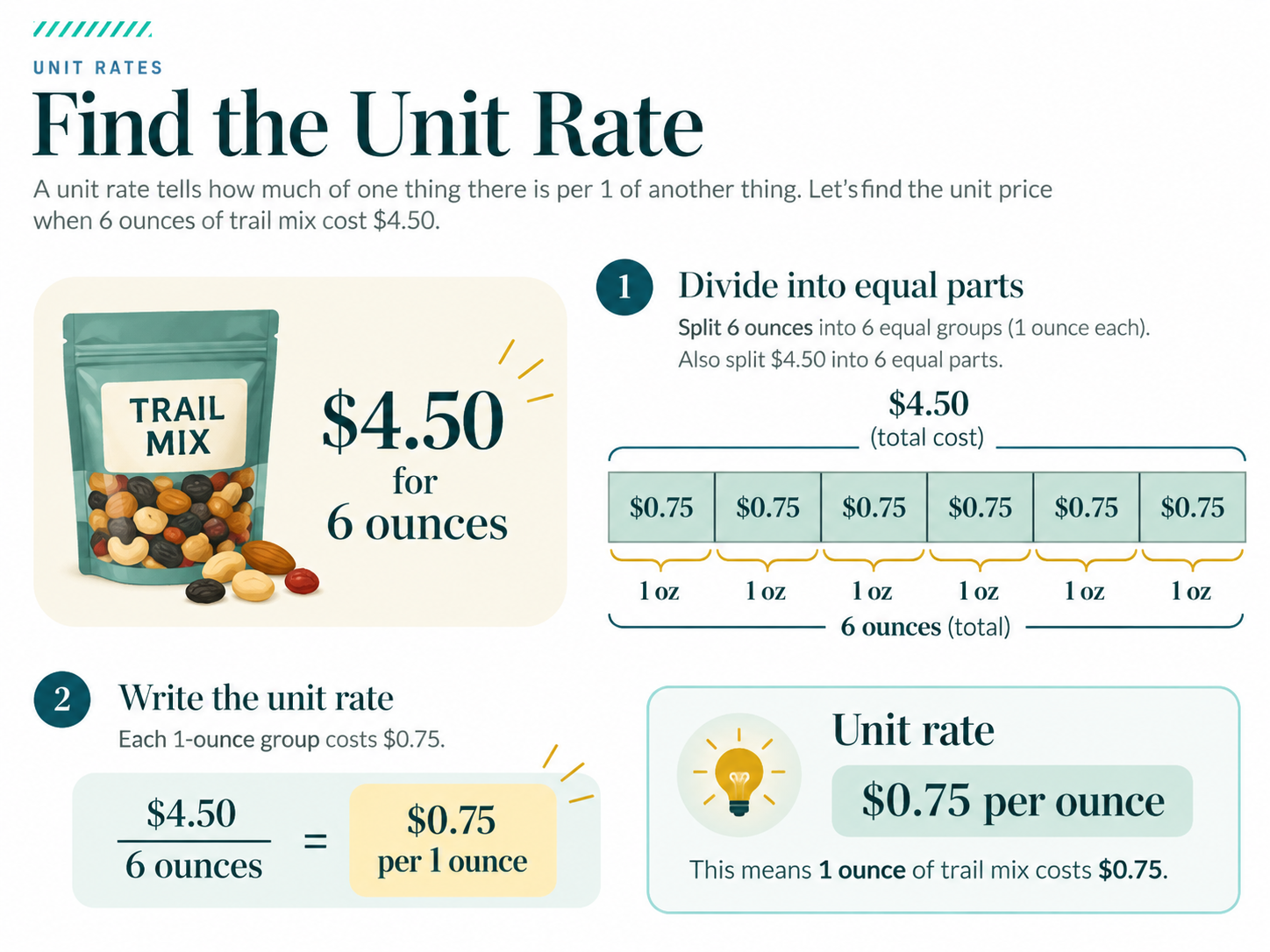
A ratio compares quantities, such as $4.50 to 6 ounces. A rate is a ratio between quantities measured in different units. A unit rate describes how much of one quantity corresponds to one unit of the other.
The word per means “for each one.” For example, $0.75 per ounce means that each ounce costs 75 cents.
Six ounces cost $4.50 in total. Each ounce accounts for an equal share of the cost. Divide the total cost into six equal parts.
$4.50 ÷ 6 = $0.75 per ounce. Multiplying $0.75 × 6 = $4.50 checks the result.
03 · EXPLORE
Suppose one ounce costs $0.75. Two ounces cost twice as much, and four ounces cost four times as much. Both the weight and the cost change together.
| Ounces | 1 | 2 | 4 | 6 |
|---|---|---|---|---|
| Cost | $0.75 | $1.50 | $3.00 | $4.50 |
What about the other bag? $6.40 ÷ 8 = $0.80 per ounce. Bag A costs $0.75 per ounce, so it is cheaper by $0.05 per ounce.
04 · WATCH IT SOLVED
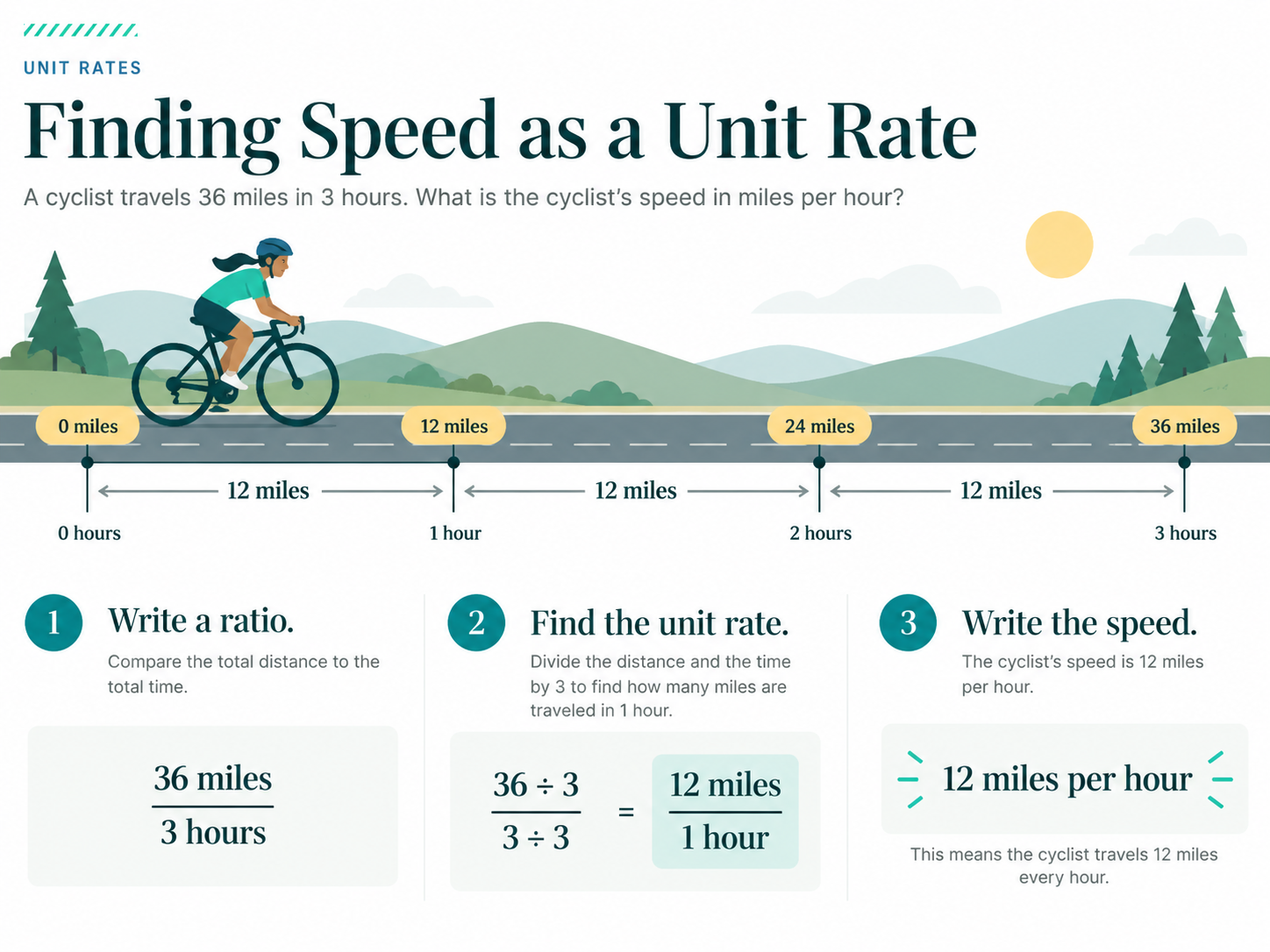
A cyclist rides 36 miles in 3 hours at a constant speed. What is the speed in miles per hour?
Five notebooks cost $12.50. Divide the total cost by the number of notebooks: $12.50 ÷ 5 = $2.50 per notebook. Check by multiplying $2.50 × 5 = $12.50.
05 · SOLVE TOGETHER
Four movie tickets cost $30. What is the price for one ticket?
First, decide which quantity you want for one unit. The question asks for dollars per ticket. Divide total dollars by the number of tickets.
06 · PRACTICE
Complete 12 varied questions. Each answer gets instant feedback. If you make an error, use the hint and revise your answer before going on.
07 · APPLY AND REFLECT
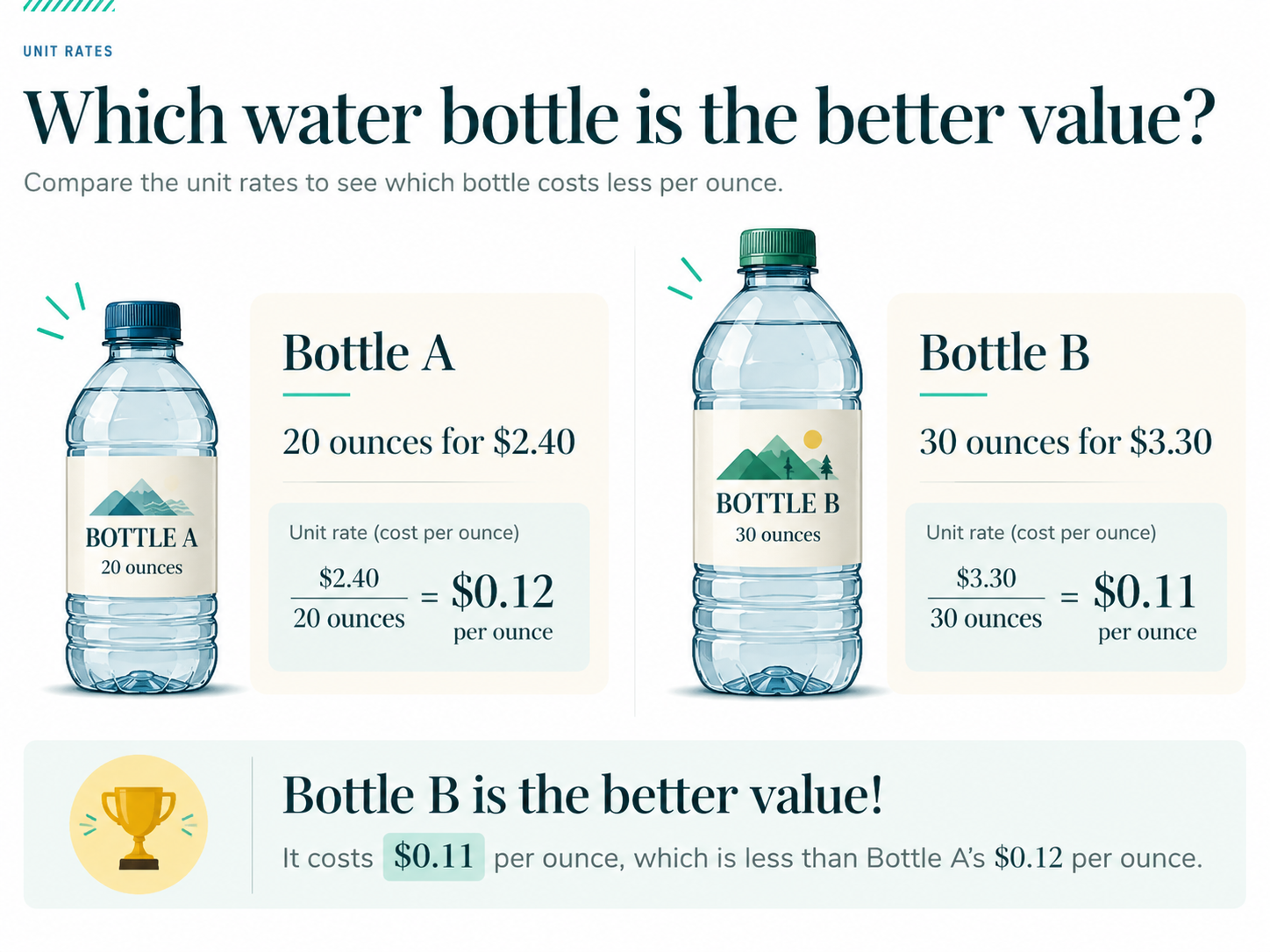
Water bottle A: 20 ounces for $2.40. Bottle B: 30 ounces for $3.30.
Bottle A costs $2.40 ÷ 20 = $0.12 per ounce. Bottle B costs $3.30 ÷ 30 = $0.11 per ounce. Bottle B is the better value per ounce, although a shopper might still choose the smaller container.
Why isn’t comparing only the total price a fair way to decide which package gives you the best value? Describe one time you could use unit rates outside school.
Pilot lesson: results are not submitted to the teacher dashboard. Future versions will include student sign-in and progress reports.
08 · YOUR RESULTS
You’ve completed the learning pathway. Here’s how you performed on your 12 independent practice problems.
This score measures independent-practice first attempts. Select Submit My Score below to save your results to the teacher dashboard. Google Classroom posting depends on your teacher’s sync setup.
Your score will be saved to the Learning Pathways teacher dashboard.