
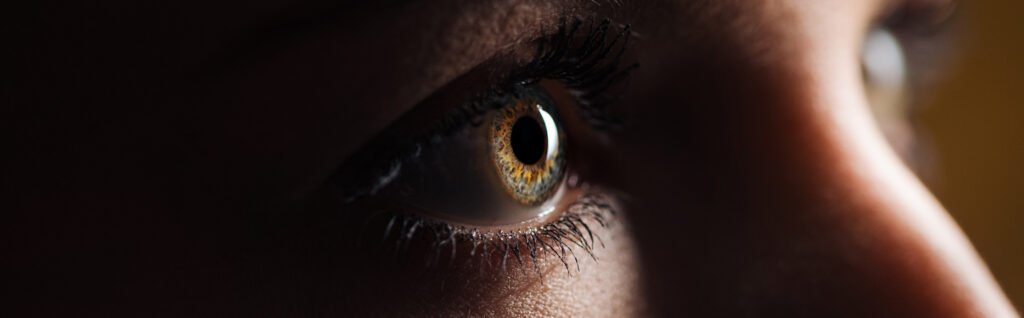
👁️ How Are You Reading This Right Now?
Take a second and look at something near you.
Maybe it is your Chromebook, your hand, a pencil, or the person sitting across from you.
It feels like your eyes are simply looking at the object.
But that is not really what is happening.
Your eyes are receiving light, your eye structures are bending and detecting that light, and your brain is turning information from that light into what you experience as vision.
All of this happens incredibly quickly.
So how does it work?
That is what we are going to investigate over the next several posts.
By the end of this series, you will know enough about the eye to examine a real sheep eye and understand what you are actually looking at.
💡 Step 1: You Need Light to See
Imagine walking into a room with absolutely no light.
Could you see?
No.
Even if your eyes were wide open, you would not be able to see the objects around you.
That gives us our first important idea:
Vision begins with light.
Most objects do not create their own light.
Instead, light from a source such as the Sun or a lamp hits an object and reflects, or bounces, off it.
Some of that reflected light then travels into your eyes.
So when you look at a red backpack, your eyes are actually detecting light that has reflected from that backpack.
👁️ Step 2: Light Enters the Eye
Light first passes through the cornea.
The cornea is the clear, curved surface at the front of your eye. It begins bending incoming light so it can be focused.
Next, light passes through an opening called the pupil.
Here is something many people misunderstand:
Your pupil is not a black object.
It is an opening.
The colored part surrounding it is called the iris. The iris can change the size of the pupil, helping control how much light enters the eye.
Then the light passes through the lens.
The lens works with the cornea to focus light toward the back of the eye.
🧠 Step 3: Light Reaches the Retina
At the back of your eye is a thin layer of tissue called the retina.
The retina contains special light-sensitive cells called photoreceptors.
When light reaches these cells, something amazing happens.
The photoreceptors begin changing information from light into electrical signals that the nervous system can use.
Those signals eventually travel through the optic nerve toward the brain.
Then your brain processes the information.
That is when you experience what we call seeing.
🔄 The Path of Vision
Here is the basic process:
Light source → Object → Eye → Retina → Optic nerve → Brain
Notice something important.
Your eyes collect visual information, but your brain plays a major role in creating your visual experience.
The National Eye Institute puts it simply: vision depends on your brain as much as it depends on your eyes.
So technically, your eyeballs are not doing all the work.
Your brain would like some credit too.
🧠 Quick Check
Think about these before moving on:
1. Why can’t you see an object in complete darkness?
2. Is the pupil an actual structure or an opening?
3. What happens when light reaches the retina?
4. What carries visual information from the retina toward the brain?
🔬 Vocabulary to Know
Light
Energy that allows us to see objects.
Reflection
When light bounces off a surface.
Cornea
The clear front surface of the eye that begins bending incoming light.
Pupil
The opening that allows light into the eye.
Lens
A clear structure that helps focus light.
Retina
Light-sensitive tissue at the back of the eye.
Optic Nerve
The bundle of nerve fibers that carries visual information from the retina toward the brain.
✍️ Your Blog Response
Your response must show that you understand how vision begins.
Write one complete paragraph of at least 5 sentences answering this question:
Imagine you are looking at a bright yellow school bus. Explain what must happen from the moment light hits the bus until you are able to see it.
Your response must correctly use these four terms:
light • retina • optic nerve • brain
Then answer:
Which is more responsible for vision: the eye or the brain?
Support your opinion using at least one piece of scientific evidence from today’s reading.
Do not simply list the parts. Explain how they work together.
When you’re finished, check out the rest of our blog for more tips, ideas, and activities to help you learn and grow. Be sure to follow our classroom Instagram page for behind-the-scenes moments, project highlights, and fun updates. Let’s work together to make learning fun, exciting, and something you look forward to every day!



33 Responses
I think they both play parts in seeing but I think the brain is in charge of sending signals to nerves in your eye so that it knows when to open and close or just look at something pacific .
In my opinion, the eye is most responsible for vision because the eye is what sees the reflection of light and the light travels through the pupil and the retina sending signals through the optic nerves and the brain receives those signals allowing us to see. The eye starts the whole cycle and does most of the work.
Light: Energy enabling vision.
Reflection: Light bouncing off surfaces.
Cornea: Clear front surface.
Bends incoming light.Pupil: Adjustable black opening.
Admits light inside.Lens: Clear internal structure.
Focuses light precisely.
Retina: Light-sensitive back tissue. Captures the image.
The bright yellow school bus will still look like a normal school bus until the light hits the bus, now it will look like a really bright school bus but most people would wonder how does your eye detect the bright yellow bus. It detects it by hiting the Light source then its goes to the Object then the Eye and the Retina ,Optic nerve and the Brain but after people knowing this people would have a debait about who does the most work.The eye or the Brain but to be honest it will be the brain because without the brain we wouldn’t know what would be infront of us.
The optic nerve works by the bundle of nerve fibers that carries visual information from the retina towards the brain.The retina is a light sensitive tissue at the back of the eye.The light is a energy that helps us see objects.And the brain works by creating our visual experience. they all work together by different parts like The light allowing us to see objects then reflection when light bounces off of a surface.
Cornea: Clear front surface.
Bends incoming light.Pupil: Adjustable black opening.
Admits light inside.Lens: Clear internal structure.
Focuses light precisely.Retina: Light-sensitive back tissue. Captures the image.
If I look at a school bus, I will see yellow light.
First the light passes through the cornea and it begins bending incoming light so it can be focused so the light passes through the pupil which helps control how much light enters the eye. Then the light passes through the lens so that it controls how much light it can focus light toward the back of the eye.the photoreceptors begin changing information from light into electrical signals that the nervous system can use. Those signals eventually travel through the optic nerve toward the brain.
In my opinion the brain is more responsible for the vision because if the brain wasn’t that responsible for vision than a lot of people would’t be able to see because light goes in your eye and its the retina than a optic nerve sends it to the brain but if the eye was more responsible than most of us would have a blurry vision. and that is why the brain helps with eyesight.
At the back of your eye there is a thin layer of tissue called the retina. The retina contains special light-sensitive cells called photo receptors. When light reaches these cells, something amazing happens. The photoreceptors begin changing information from light into electrical signals that the nervous system can use. Those signals eventually travel through the optic nerve toward the brain. Then your brain processes the information. This is when you experience what we call seeing. Your brain is more responsible than the eye.
if I was looking at a bright yellow school bus and before I saw it I would think that something might happen but I don’t know yet what will happen if I went and saw the bright yellow school bus and what I was able to see was a bright yellow school bus but I would think that its really cool and to see that kinda bus but if I wouldn’t have saw it then i don’t know what would happen if i didn’t see it the yellow school bus
So the first thing that would have to happen is the Sun must reflect of the bus so that the cornea can bend it then the pupil opens to allow the light in to the eye. “Then at the back of your eye is a thin layer of tissue called the retina”. “The retina is contains a special light-sensitive cells called photoreceptors”. “When light reaches these cells, something amazing happens, the photoreceptors begin changing information from light into electrical signals that the nervous system can use”.Those signals eventually travel through the optic nerve toward the brain
then your brain processes the information that is when you experience what we call seeing”. “Then the opitc nerve is a bundle of nerve fibers that carries visual information from the retina to the brain”. Then the most responible for seeing the brain because the brain does about 90% of the actual work by translating those raw signals into color, shape, depth, and meaning.
When you look at a bright yellow school bus, light from a source like the sun reflects off the bus and enters your eyes. This reflected light passes through the cornea, pupil, and lens, which bend and focus it toward the back of the eye. Once the light reaches the retina, special photoreceptor cells convert it into electrical signals. These signals travel along the optic nerve directly to the brain, which processes the information so that you can finally see the yellow bus. In my opinion, the brain is more responsible for vision because, as the text states, “vision depends as much on the brain as on the eyes,” meaning that the eyes merely gather information, while the brain creates the visual experience.
The moment when the light hits the bright yellow school bus, the Reflection of the light that bounces off the bright yellow school will go to the Cornea, the Cornea is the clear front surface of the eye that begins bending incoming light, so when the light is going to the Cornea, the Cornea will begin to bend so the light could pass though, next the light will pass though the Pupil because its a opening to allows the light so go in the eye, next the Lens will helps to focus the light better, next after the light go though the Lens, it will go to the Retina, the Retina is a Light-sensitive tissue at the back of the eye. So when the light goes through the Lens it will stop at the Retina because the Retina will absorb the light, then the Optic Nerve will carry out the visual information from the retina toward the brain.
The brain is more responsible because the brain processes the information form the Optic Nerve.
I think the brain does more by sending signals to the brain and stuff, its pretty unexplainable but its also mostly the light because the colors reflects off the lightb which makes you able to see it.
When the light from the school bus hits my eye, this process happens: First, the light hits my cornea and passes through. Then the light goes through the retina. Then optic nerves send it to my brain and signals that I am looking at something with color. That is how I see the color of the yellow school bus.
When you look at a yellow school bus the light reflecting off of it bounces to your cornea and the cornea bends light that comes so that it can pass through. Then, through the opening of the pupil the light goes through there and from there the lens will focus the light better. Once the light goes through the lens it next stops at the retina so it can get absorbed. The Optic Nerve brings the visual information from the retina to the brain so it can process the information.
This process takes place when the school bus’s light strikes my eye: The light first strikes and travels through my cornea. The light then passes through the retina. My brain receives a signal from the optic nerves that I am viewing a colorful object. That’s how I interpret the yellow school bus’s color.
I think that the brain does more because it can give signals and senses. Light will past through your cornea then will pass through to the retina and then the optic nerves sends it all the way to my brain to show me color.
At the back of your eye there is a thin layer of tissue called the retina. The retina contains special light-sensitive cells called photo receptors. When light reaches these cells, something amazing happens. The photoreceptors begin changing information from light into electrical signals that the nervous system can use. Those signals eventually travel through the optic nerve toward the brain. Then your brain processes the information. This is when you experience what we call seeing. Your brain is more responsible than the eye.
When you look at a bright yellow school bus the light will reflect off then the light travels past your cornea.Then passes the pupil which allows the light to pass. After that it will go past the Lens which helps the eye to focus on things from different distances.Passes the Retina which is a sensitive tissue at the back of the eye. Then it passes through the Optic Nerve which carries visual signals toward the brain. In my opinion the eye is more responsible for the vision since it does more work than the brain, but both are very necessary.
Take a second and look at something near or the person sitting across from you It feels like your eyes are simply looking at the object But that is not really what is happening Your eyes are receiving light, your eye structures are bending and detecting that light, and your brain is turning information from that light into what you experience as vision.
I think the brain is more responsible for vision because it says that the pupils and lens focuses light to the retina.
If I’m looking at a bright yellow school bus I think when the lights are coming your not going to be able to see because the the two lights are very bright and when they come out eyes will start to shrink because of how bright the lights are especially if its right in front of you.
If i look at a yellow bus I think when the lights are coming your not going to see because the two lights are very very bright and when the lights come out the eyes will shrink because how much light is coming in your eyes.
Take a second and look at something near or the person sitting across from you It feels like your eyes are simply looking at the object But that is not really what is happening Your eyes are receiving light. Your eye structures are bending and detecting that light and your brain is turning information from that light into what you experience as vision. Imagine walking into a room with absolutely no light could you see no Even if your eyes were wide open you would not be able to see the objects around you. Most objects do not create their own light instead light from a source such as the Sun or a lamp hits an object and reflects or bounces off it some of that reflected light then travels into your eyes. Light first passes through the cornea the cornea is the clear curved surface at the front of your eye it begins bending incoming light so it can be focused light passes through an opening called the pupil. The colored part surrounding it is called the iris The iris can change the size of the pupil helping control how much light enters the eye .
I think it works like an advanced camera obscura that captures ambient light, focuses it, and transforms it into electrical impulses for the brain to convert into images. Also, when you’re unwell, the white part can turn red; when you smoke too much, it turns yellowish; or if your eye is very sensitive, it can get irritated by just about anything.
Your eyes are receiving light, your eye structures are bending and detecting that light, and your brain is turning information from that light into what you experience as vision. That is how eyes work.You need light to see. Even if your eyes were wide open, you would not be able to see the objects around you. Light passes through the cornea first.The cornea is the clear, curved surface at the front of your eye. It begins bending incoming light so it can be focused.Next, light passes through an opening called the pupil.Here is something many people misunderstand: the pupil is a opining not a solid object.At the back of your eye is a thin layer of tissue called the retina.The retina contains special light-sensitive cells called photoreceptors. When light reaches these cells, something amazing happens.The photoreceptors begin changing information from light into electrical signals that the nervous system can use.Those signals eventually travel through the optic nerve toward the brain.Then your brain processes the information.That is when you experience what we call seeing
Your eyes work like a camera,capturing light from you surroundings and turning it into electrical signals that your brain converts into images.
.
In order to see a yellow school bus we have to have light. Light bounces off the school bus. The light enters our eye through the cornea. The light goes through the pupil which is a hole. At the back of eye is the retina, which has photo receptors. These change the light into electrical currents that pass through the optic nerve and send a signal to the brain. The brain is more responsible for our sight because our brain is connected to our eyes.
Our eyes can work because there’s muscle moving the eyes and there’s a little string that moves it to left and right we can see the colors because without the sun the reflection cannot show but if we don’t have light we cannot see the colors like when you try to turn the lights in your room you can’t see for your room lights are on you could see all the colors in your eyes.
I think our eyes work by working together with the brain . The brain sends signals through your muscles for it you want to pick up things and etc so I think that there are muscles in our eyes that get signaled to look at something but the process for for eyes to really see is through the cornea then light with go through the pupil which is a hole so that’s how the light goes through at the back is the retina .
When the light hits the bright yellow school bus the color yellow reflects off the place it looks and it travels to your eyes.The reflection light goes inside your eye by going into the cornea and pupil going pass the lens and it makes it focus on the retina on the back of your eyes. I think the brain sends signals to your muscles.