
How Pollution Travels Downstream: Follow the Runoff
A pollutant does not need to begin beside a river to reach one. Follow a rainstorm across a watershed, then decide what the evidence can—and cannot—show.
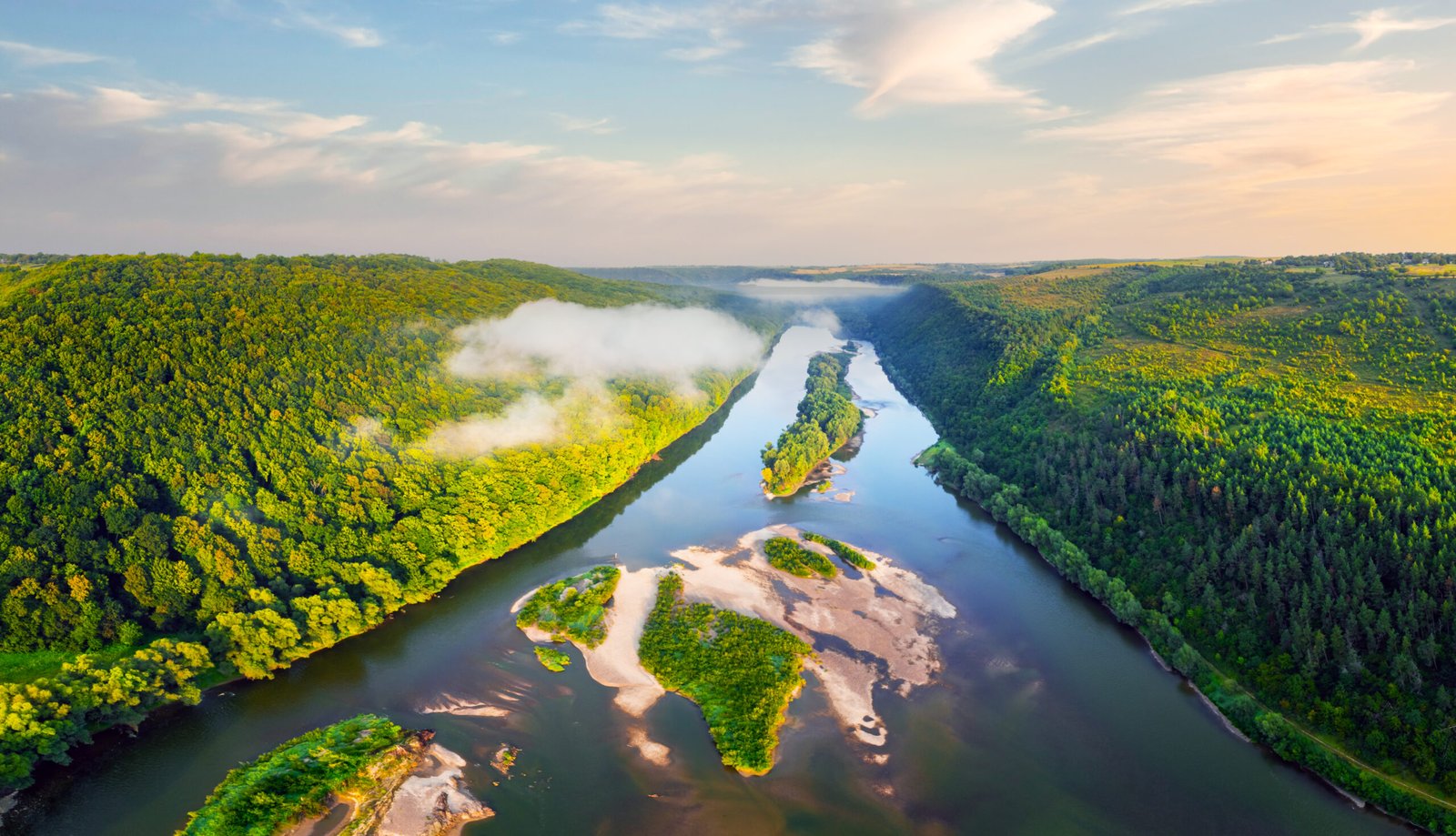
I can trace how runoff transports material through a watershed so I can explain downstream effects without claiming more than the evidence shows.
- I distinguish point-source and nonpoint-source pollution.
- I build a pathway from land to water.
- I use data for a limited claim and name what remains uncertain.
Vocabulary for the investigation
Watershed
An area of land where water drains toward a shared outlet.
Runoff
Water that moves over the land surface instead of soaking into the ground.
Impervious surface
A surface such as pavement or a roof that limits infiltration.
Point source
A discrete, identifiable conveyance such as a pipe that releases pollutants.
Nonpoint source
Diffuse pollution carried from many places, often by rain or snowmelt.
Turbidity
A measure related to how cloudy water is because of suspended material.
Trace one fictional rainstorm
Imagine a parking lot with small drops of motor oil and loose sediment. Rain falls faster than the paved surface can absorb it.
This pathway is a model, not a claim about every drainage system. Stormwater infrastructure varies. The useful idea is that moving water can pick up material, carry it, and deposit it somewhere else.
Point source or nonpoint source?
| Example | Best classification | Reason |
|---|---|---|
| A wastewater discharge leaves one pipe. | Point source | The release comes through a discrete conveyance. |
| Rain washes fertilizer from many lawns. | Nonpoint source | The material comes from many scattered places. |
| Runoff crosses several farm fields after rain. | Nonpoint source | The source is spread across the landscape. |
Real legal classifications can depend on the exact source and permit system. These examples are simplified for learning.
Why nutrients can matter
Nitrogen and phosphorus are normal parts of ecosystems, but too much entering water can speed the growth of algae and algae-like bacteria. When large amounts of that material die and decompose, oxygen in the water can decrease. Low-oxygen conditions can harm aquatic life.
This does not mean every fertilizer particle creates a dead zone. The outcome depends on amount, timing, water movement, temperature, biological activity, and other conditions.
Analyze fictional monitoring data
The table describes one fictional sampling event after rain. It is not a real investigation and does not establish a safety threshold.
| Site | Location | Turbidity |
|---|---|---|
| A | Upstream of a stormwater outfall | 4 NTU |
| B | Just downstream of the outfall | 17 NTU |
| C | 500 meters farther downstream | 11 NTU |
Your task: Describe the pattern, calculate the difference between Sites A and B, and write one claim the data support.
Sentence frame: “Turbidity was ___ NTU higher/lower at ___ than at ___. This supports the limited claim that ___. It does not prove ___ because ___.”
Compare with a model response
Site B measured 13 NTU higher than Site A because 17 − 4 = 13. In this fictional event, the highest measured turbidity occurred just downstream of the outfall.
The pattern does not prove that the outfall caused the entire difference. A stronger causal explanation would need repeated measurements, information about other inflows, sampling methods, rainfall, and possible upstream sources.
What can slow or filter runoff?
Vegetated areas, rain gardens, wetlands, and other green stormwater features can slow water, encourage infiltration, or trap some sediment and pollutants before runoff reaches a stream. Their performance depends on design, maintenance, soil, rainfall, and the pollutant involved; no single feature removes everything.
Your watershed explanation
- Choose one material: oil, sediment, fertilizer, litter, or pet waste.
- Draw a five-step pathway showing how rain could move it from land to water.
- Label one place where the material could be slowed, captured, or reduced.
- Write one sentence about what evidence you would collect to test the model.
Share your pathway and explanation in the comments or your teacher’s assigned response space. To explore related systems, visit the virtual labs.
Sources to explore
The U.S. Environmental Protection Agency overview of nonpoint-source pollution explains how runoff can carry pollutants into surface and groundwater. EPA also describes how excess nutrients can contribute to algal growth and low-oxygen conditions. The U.S. Geological Survey runoff guide explains how stormwater moves across land and can pick up pollutants. The pathway and dataset here are original teaching models.




6 Responses
I would make a small model of a river and add small amounts of oil into it to see how the water changes when there is waste in it.
Turbidity was 17 NTU higher/ at just down stream of the outcall than at upstream of a storm water outfall . This supports the limited claim that down stream is higher NTU then down stream NTU. It does not prove that down stream is better because different streams have different NTU levels.
Turbidity was 13 NTU higher at Site B than at Site A. This supports the limited claim that the stormwater outfall increases water turbidity immediately downstream. It does not prove that the outfall permanently pollutes the entire river system because turbidity decreases farther downstream at Site C (to 11 NTU), showing that the water begins to clear up or dilute as it moves away from the source.
Turbidity was 13 NTU higher at site B than at site A. This supports the limited claim that the storm water outfall introduces sediment or particles that increase water cloudiness. It does not prove that the outfall is the only source of pollution because other factors such as natural runoff from the banks between the sites, were not controlled or measured.
Rainwater can collect pollution such as oil, fertilizer and dirt, as it runs over the land. These pollutants can wash down gutters and storm drains into streams and rivers. This can be damaging to water quality and aquatic life especially if an excess of nutrients enters the water. Plants wetlands and rain gardens can help slow runoff, and trap some pollution before it reaches the water.
Turbidity was 13 NTU higher at Site B than at Site A. This supports the limited claim that the outfall caused some of the difference. It does not prove that it caused all the difference, because we need more information for that.